Evidence reviewed July 28, 2026 · Sensory claims and veterinary warning signs are sourced below
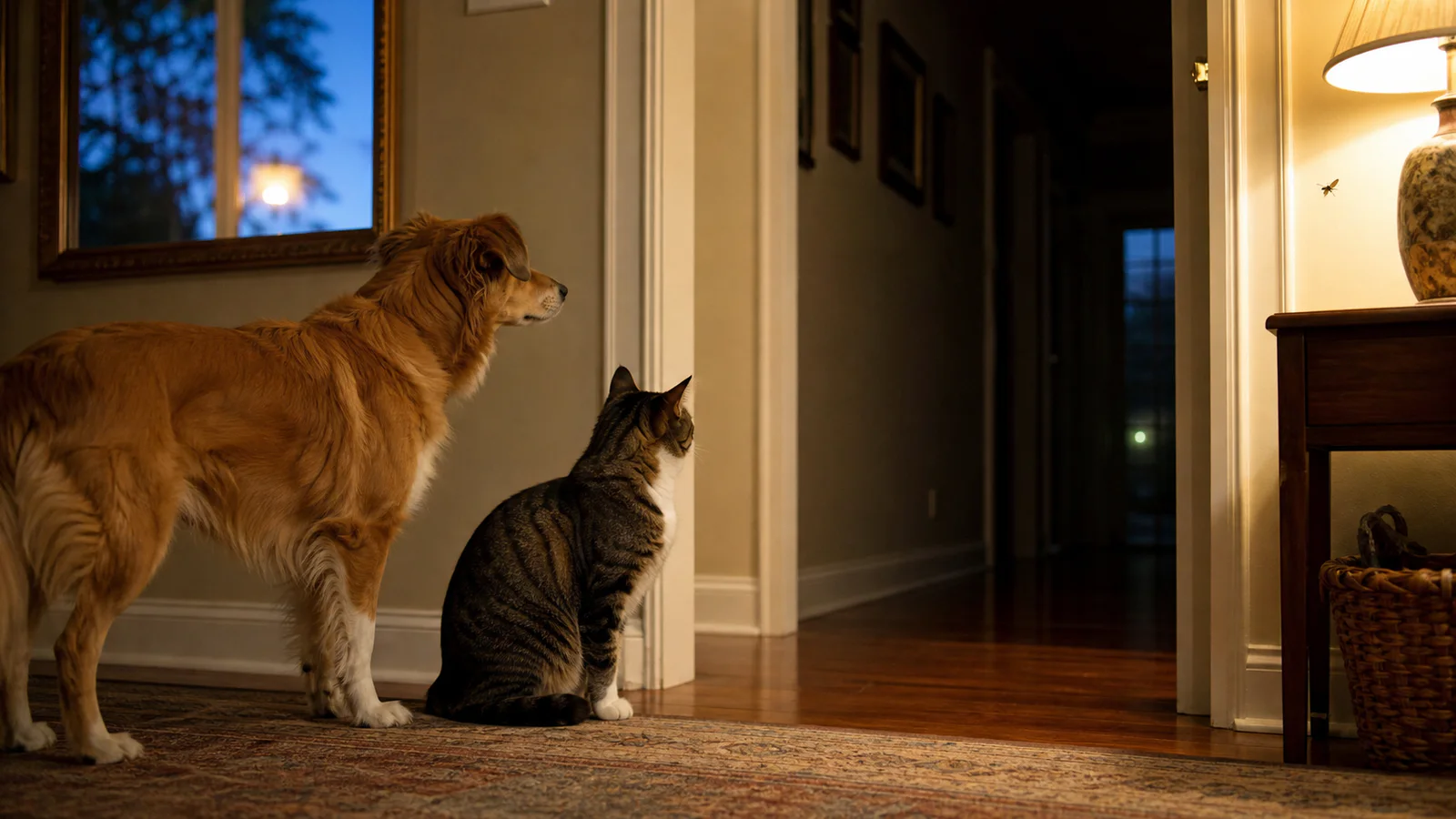
No reliable scientific evidence shows that cats or dogs see ghosts. Pets do hear, smell, see, and track patterns differently from people. A stare into an “empty” corner may have a real cause that is simply outside your attention: a moth, a reflection, the HVAC, or a mouse living rent-free in the wall.
Can cats see ghosts?
Science cannot prove a negative about every spooky story, but it has not produced reliable evidence that cats perceive spirits. It has produced excellent reasons for a cat to appear interested in absolutely nothing.
Cats can hear much higher frequencies than people. In a controlled hearing study, domestic cats responded across a remarkably broad frequency range. That makes a faint squeak, insect, electronic tone, or small animal behind drywall a better first hypothesis than a paranormal visitor. Cats also specialize in detecting small movements in dim conditions. A drifting dust mote, reflected headlights, a phone screen, or a bug near the ceiling can become tonight's feature presentation.
Watch the ears
Ears turning independently or repeatedly toward one point suggests the cat is locating a sound, even when you hear nothing.
Change the light
If closing blinds or switching on a lamp ends the stare, motion or reflection just defeated the ghost in one round.
Can dogs see ghosts?
There is no reliable evidence that dogs see ghosts either. Dogs can react to distant footsteps, wildlife outdoors, scent carried under a door, a neighbor moving through a shared wall, or the tiny routine changes that tell them someone is about to arrive.
A bark at an apparently empty room may also be learned behavior. If every bark makes the household freeze, investigate, speak excitedly, and offer reassurance, the performance gets a very attentive audience. That does not mean the dog invented the original trigger; it means the encore may have benefits.
Check the nose
Sniffing at a door, vent, baseboard, or window points toward a scent source or outdoor animal rather than a visual mystery.
Check the pattern
Note the time. Elevators, deliveries, sprinklers, heating systems, and neighbors often keep schedules your dog has memorized better than you have.
Cats versus dogs: the likeliest explanations
| What you notice | Common cat possibilities | Common dog possibilities |
|---|---|---|
| Staring at a wall | Insect, tiny reflection, prey sound, scent change | Sound through the wall, scent trail, learned alerting |
| Looking into a dark hall | Low-light motion or a moving shadow | Distant movement, footsteps, or household routine |
| Sudden vocalizing | Prey excitement, frustration, stress, discomfort | Alerting, anxiety, outside noise, discomfort |
| Repeated new behavior | Record it and consider environmental, sensory, pain, neurologic, and age-related changes with your veterinarian | |
The 90-second “ghost” check
- Turn on the lights. Look for insects, moving cords, reflective surfaces, shadows, and screens.
- Close the blinds. Passing cars and outdoor animals can throw moving light across walls and ceilings.
- Pause moving equipment. Check fans, vents, chargers, monitors, pest devices, plumbing, and HVAC without opening electrical equipment.
- Listen near the area. A quiet moment can reveal pipes, rodents, neighbors, or a loose object.
- Write down the pattern. Note time, place, duration, what happened immediately before, and whether food, sleep, movement, elimination, or mood has changed.
- Record a short video. Repeated clips give your veterinarian more useful information than “the dog argued with the hallway again.”
When apparently spooky behavior needs a veterinarian
A brief, isolated stare in a pet who otherwise eats, sleeps, moves, plays, and eliminates normally can usually be investigated and monitored. Contact your veterinarian when staring, barking, hiding, pacing, or confusion is new, repeated, escalating, or accompanied by changes in appetite, sleep, thirst, elimination, mobility, vision, hearing, vocalization, or personality.
Senior pets deserve particular attention. Veterinary guidance on canine and feline cognitive dysfunction includes disorientation, sleep-wake changes, altered interaction, house-soiling, activity changes, and anxiety. Cornell also lists long periods of blank staring among possible signs in older cats. Those signs have medical explanations to investigate; they are not proof that the retirement home has invisible tenants.
Use an emergency clinic for collapse, breathing difficulty, injury, marked unresponsiveness, repeated seizure-like movements, or another sudden severe change. Keep the joke out of this part and do not delay care for a paranormal theory.
Frequently asked questions
Why does my cat stare at the wall?
Start with insects, reflected light, a faint sound, prey behind the wall, or a scent. If the behavior is new or repeated, especially in a senior cat or alongside other changes, record it and ask your veterinarian.
Why does my dog bark at an empty room?
The room may not be empty from the dog's sensory point of view. Check for sound through walls or vents, outdoor movement, and scent under doors or windows. Also note whether attention is reinforcing repeated barking.
Can pets sense things humans cannot?
Yes. Cats and dogs differ from people in hearing, smell, low-light vision, motion detection, and attention. Detecting a real stimulus that you missed does not identify that stimulus as supernatural.
Should I film the behavior?
Yes, when it is safe. A short clip showing the pet's eyes, body, response to your voice, and the surrounding room can help identify patterns and can be useful to a veterinarian.
Final verdict
Your pet may genuinely perceive something that you do not. That is the fascinating part. The evidence supports sharper or different sensory attention—not proof of ghosts. If the cat starts charging rent to an invisible roommate, however, keep the camera running.
Sources and further reading
These sources support the sensory abilities, behavior guidance, and veterinary warning signs discussed above.
- Heffner and Heffner: Hearing range of the domestic cat
- Louisiana State University School of Veterinary Medicine: Hearing ranges in dogs and cats
- AAHA: Managing cognitive dysfunction and behavioral anxiety
- Cornell Feline Health Center: Cognitive dysfunction
- Merck Veterinary Manual: Behavior problems of cats